


Clontarf House, Clontarf
Light, shadow, and calm: Inside Clontarf House
“It sits right on Middle Harbour and faces south-west towards Mosman, with the Spit Bridge to the west and the entrance to Sydney Harbour to the east,” says architect Phillip Mathieson. “It’s a beautiful, harbourside suburb.”
Set low on the site, the house avoids any sense of detachment from its surroundings. Its placement allows internal spaces to feel closely aligned with the landscape beyond.
“The home sits at the bottom of a natural slope, just before the water, and has a very close relationship to the waterfront,” explains Mathieson. “We wanted to capture a real intimacy between the internal living spaces and the harbour.”

The architecture is deliberately restrained, allowing orientation, climate and outlook to guide key decisions.
“As a studio, we approach our work from a timeless perspective rather than following trends,” says Mathieson. It’s really about responding to the setting and landscape, and in this case, the view to the water.”
The brief from the clients reinforced this thinking, with an emphasis on a relaxed way of living that could easily accommodate guests.
“They really wanted to embrace the best of coastal living,” he says.

In response, the plan is arranged as a series of linked zones rather than a single open expanse. Each area supports a different mode of use, while still maintaining a sense of continuity throughout.
This spatial layering creates a rhythm to the house. Moving through it, spaces expand and contract, offering moments of enclosure before opening outward again.
“From the courtyard to the kitchen and out to the water, each space supports a different way of living while maintaining a strong visual and spatial connection,” he says.


Light plays a central role in reinforcing this sequence. It shifts across surfaces and through openings, subtly changing the atmosphere of each space over the course of the day.
“It’s really about how you experience the home, the way light moves through spaces, and the connection between inside and outside,” says Mathieson.
At the entry, a faceted steel gate introduces this dynamic, casting patterned shadows that change with the sun. Inside, finishes such as Venetian plaster catch and soften light, helping to guide movement.


The material palette is intentionally restrained, with variation coming through texture. This maintains a cohesive architecture whilst still offering moments of contrast.
“The material palette is relatively limited, but it’s enriched through texture and detail,” he says.


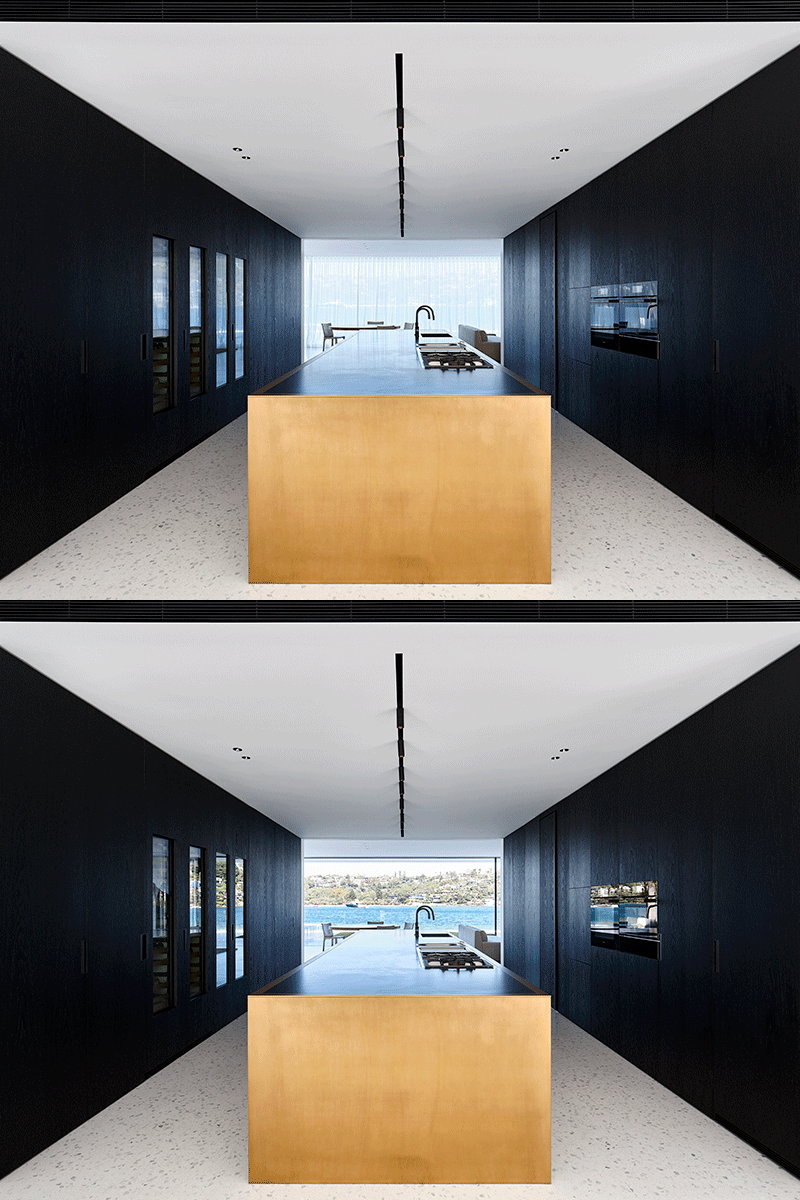
In the kitchen, darker tones create a sense of pause within the overall sequence. It’s a space that briefly compresses before the house opens again into more social areas.
“One of the things we’re always trying to do is give different experiences as you move through the house…”
These shifts are subtle but deliberate, shaped by changes in light, scale and material rather than abrupt transitions.
“Whether it’s walking from the rear courtyard through the darker kitchen space and back out to the pool table area, or watching light reflect off surfaces, movement through the home is constantly animated by light and shadow,” explains Mathieson.

The result is a home that feels considered without being overly controlled. One that adapts easily to different ways of living.
“One of the most rewarding things for us is not just seeing the project completed, but seeing the family actually living in it as they’d hoped,” says Mathieson. “Watching the family gather with friends—whether in the courtyard, around the pool table, or overlooking the water—has been incredibly rewarding.”


Selecting Sun Shading
Large sliding and stacking glazed panels dissolve the boundary between interior and terrace, opening the principal living spaces directly to the harbour. Where those openings are at their most generous, preserving the sightline was as critical as managing solar performance. Early collaboration with Shade Factor ensured each system was resolved within the architecture from the outset.
"Shade Factor's expertise was really important, particularly given the coastal environment and the technical demands of the large spans," says Mathieson. "We worked closely with them to integrate brackets and systems into the facade so everything felt slimline, resolved and unobtrusive."

Inside, the Blindspace concealment system is installed throughout — including in the billiards room, the living spaces, the bedrooms and bathrooms — housing internal roller blinds within flush-mounted cassettes that sit invisibly within the ceiling plane.


TrackTrim recessed curtain tracks by Blindspace run alongside, integrating drapery flush with the ceiling line so that neither track nor hardware interrupts the view to the water. Over these broad openings, the shading disappears when retracted.


Outside, Warema Terra K70 motorised folding arm awnings with integrated valance extend the spatial sequence outward — one to the rear courtyard, two to the waterfront terrace. Together they stitch the two ends of the house to the landscape, allowing the family to occupy both spaces fully across changing conditions. They project up to three metres and retract completely when not in use, leaving the facade uninterrupted.

"It was important that these systems were fully integrated," says Mathieson. "They are part of the design, not separate elements — subtle, technical and functional, yet refined."
Through this approach, the house achieves a consistent, uncluttered expression while responding to the practical demands of its coastal environment.
Victoria
+61 3 9558 3009
Boonwurrung Country
6 Plane Tree Avenue
Dingley Village VIC 3172
New South Wales
+61 2 9136 6090
Kuring-gai Country
7A Green Street
Brookvale NSW 2100

Shade Factor is proud to be the exclusive agents of Warema and Caravita in Australia and engages in projects all around the world.